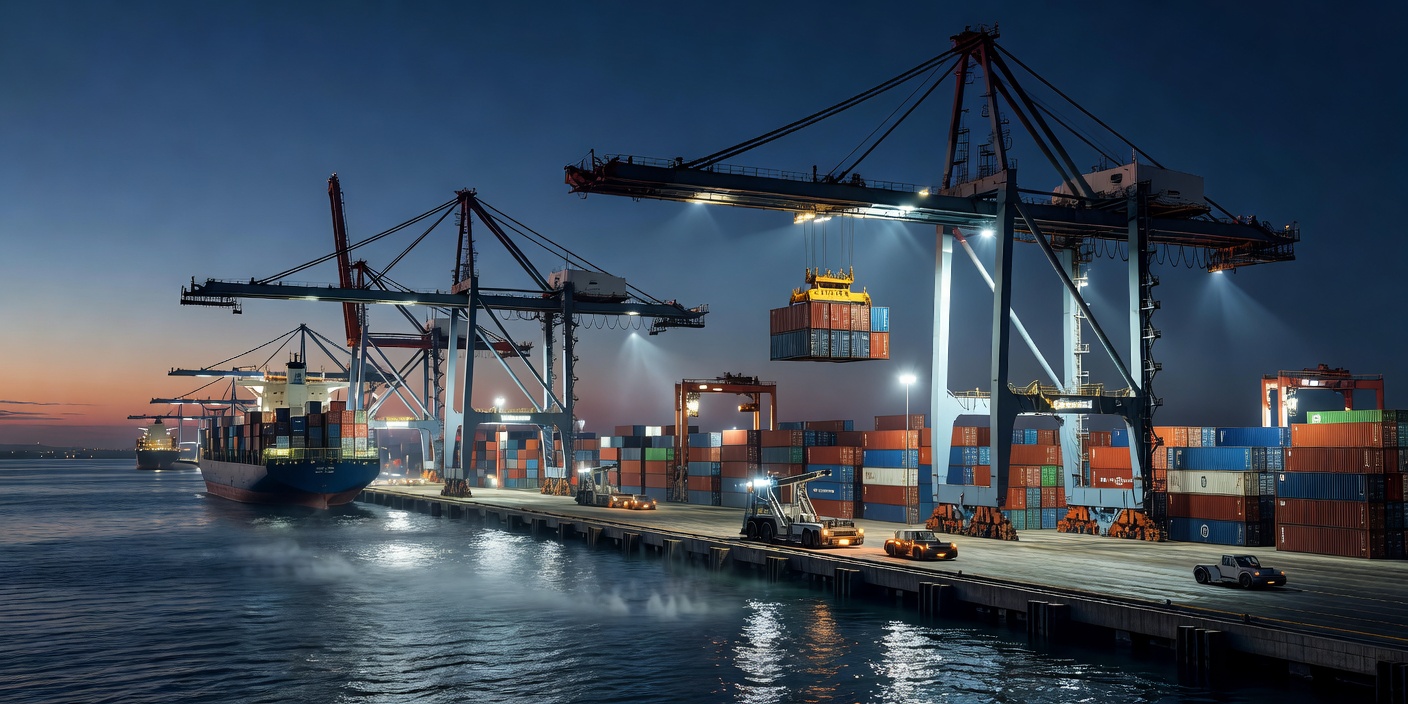
1. Marine Terminal Classification
Different vessel and cargo profiles require dedicated quayside infrastructure. Major European terminal categories include:
- Container Terminals (Lo-Lo): Lift-on / lift-off facilities equipped with rail-mounted Ship-to-Shore (STS) gantry cranes. Capable of handling twin-lift or tandem 40ft containers. Container stacking yards utilize Automated Stacking Cranes (ASC) or Rubber-Tyred Gantries (RTG).
- Roll-on / Roll-off (Ro-Ro) Terminals: Specialized quays with adjustable shore-to-ship ramps (linkspans). Designed for self-propelled cargo, unaccompanied freight trailers, and automotive imports. Prioritize fast turnarounds over vertical stacking.
- Breakbulk & Heavy Lift Quays: Equipped with mobile harbor cranes, heavy-capacity quay pavements, and open ground storage for project equipment, steel coils, and wind turbine components.
- Liquid and Dry Bulk Stations: Fully closed conveyor corridors or pipeline manifolds feeding storage tanks, silos, or rail hoppers, isolated from container traffic.
2. The Container Terminal Operational Cycle
The container path inside a European terminal follows precise stages governed by the Terminal Operating System (TOS):
| Stage | Mechanism | Operational Risk | Verification Requirement |
|---|---|---|---|
| STS Discharge | Gantry spreader locks onto container twistlocks | Wind downtime (>20 m/s), vessel surge | Vessel stowage bay plan alignment |
| Yard Transfer | AGVs, straddle carriers, terminal tractor units | Internal traffic congestion, yard bottlenecks | Container ID / ISO code scanning |
| Yard Stacking | Automated Stacking Cranes in dedicated yard blocks | Unproductive reshuffling (“digging”) | Assigned block coordinate in TOS |
| Customs Clearance | Electronic release, mobile X-ray scanning, phytosanitary checks | Inspection holds, documentation discrepancies | Import Single Administrative Document (SAD) |
| Landside Gate-Out | Optical Character Recognition (OCR) gate, biometric driver checks | Vehicle booking system slot expiry | Valid pre-announcement pin (e.g., Portbase, Portic) |
3. Gate Appointment Systems & Demurrage Rules
Modern European terminals do not allow unscheduled truck entries. Drayage hauliers must book time-slots through electronic Vehicle Booking Systems (VBS). Failure to secure a slot before vessel free-time expires leads directly to financial costs:
Demurrage: Charges levied by the ocean carrier when equipment remains inside the terminal past agreed free days.
Detention: Charges levied when a container is removed from the terminal but not returned empty to the carrier's depot within the agreed timeframe.
Dwell Storage: Charges assessed directly by the terminal operator for occupying ground surface beyond permitted allowances.
Operational Check: Terminal Selection
Good For
- Automated terminals for consistent, high-productivity vessel discharge.
- Facilities with on-dock rail yards to eliminate drayage transport fees.
- Terminals operating 24/7 automated gate systems for night-time collection.
What to Check
- Strictness of truck slot booking intervals and late arrival penalties.
- Presence of dedicated border control inspection posts (BCP) on site.
- Dangerous goods (ADR/IMDG) holding limits and class restrictions.
Related Technical Guides
Examine how terminal throughput connects to wider transit chains: