1. Comparative Vector Overview
Every transport vector balances capacity, flexibility, and infrastructure constraints:
| Mode | Unit Capacity | Core Advantage | Primary Limitation |
|---|---|---|---|
| Feeder Vessel (Short-Sea) | 300 – 1,800 TEU | Bypasses congested road networks; low emissions per ton | Subject to coastal weather and port call rotations |
| Block Train (Rail) | 60 – 100 TEU (approx. 600–740m) | High speed over medium-to-long inland distances | Track-gauge variations, electrified vs diesel segments |
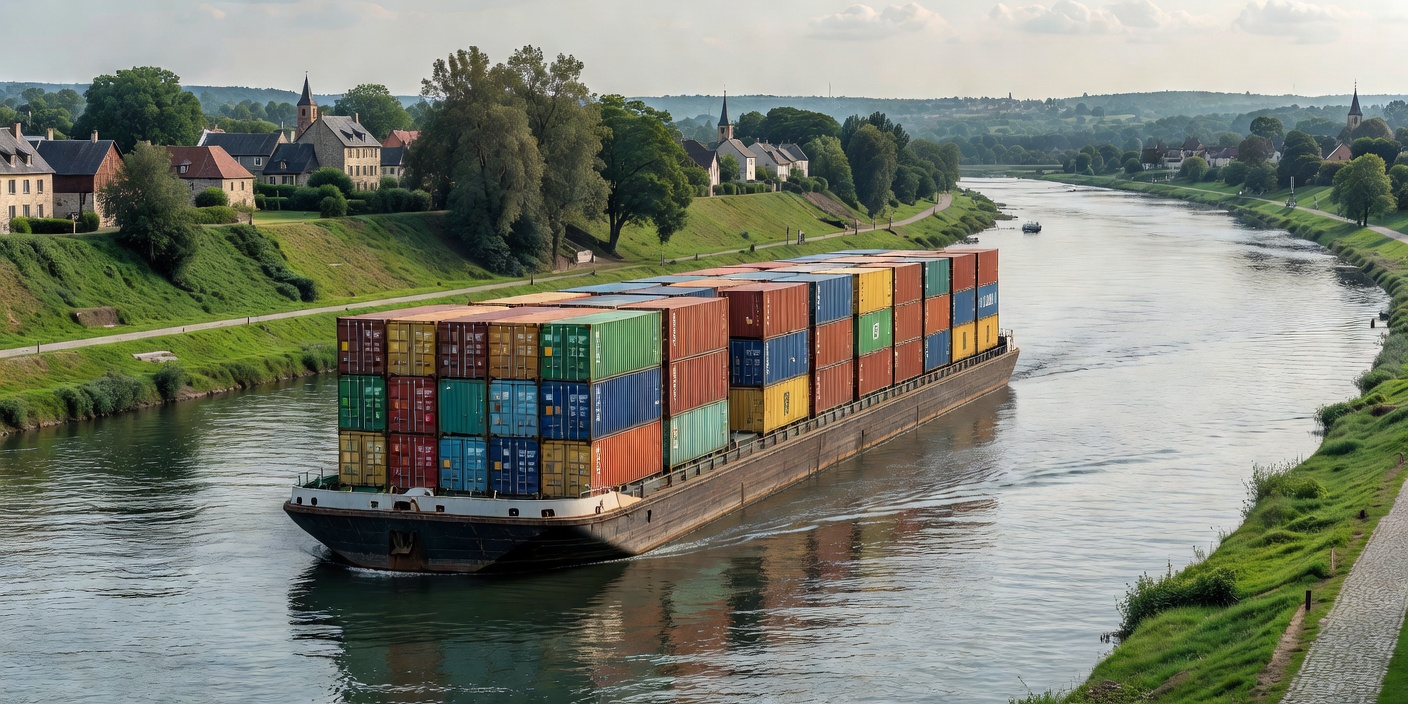
| Inland Waterway (Barge) | 90 – 400 TEU (pushed convoys higher) | High mass volume; lowest cost per ton-kilometer | Draft variations from seasonal river low-water levels |
| Road Haulage (Truck) | 1 – 2 TEU (Standard 40t gross) | Point-to-point flexibility; direct warehouse delivery | Driver rest-hour rules, highway weight limits, toll structures |
2. Rail Freight Corridors (TEN-T)
European rail connections are structured around the Trans-European Transport Network (TEN-T) Core Freight Corridors. These lines provide standard track gauge (1,435 mm) across central Europe, though gauge transitions occur at the borders of the Iberian Peninsula (1,668 mm Iberian gauge) and the Baltic / Eastern systems (1,520 mm gauge).
Block trains operate on fixed slot schedules connecting ports like Rotterdam, Antwerp, Hamburg, and Trieste with inland dry ports in Germany, Austria, Switzerland, Poland, and the Czech Republic.
3. Inland Waterway Vectors (Rhine & Danube Systems)
The Rhine corridor links major North Sea coastal terminals with industrial manufacturing clusters in western Germany, eastern France, and Switzerland. Barges offer reliable high-volume transport for heavy industrial cargo, standard containers, and bulk commodities.
Key risk factor: Kaub Gauge depth. During prolonged dry spells in late summer, water levels on the Middle Rhine may drop, forcing barges to load at 50% or 30% of capacity to reduce draft, prompting low-water surcharges (KWZ) and modal shift to rail.
Operational Check: Connection Selection
Good For
- Rail for high-value container blocks moving 350km+ into inland industrial parks.
- Inland barges for stable non-urgent replenishment into Rhine-Danube corridors.
- Direct road haulage for time-sensitive, sub-300km radial deliveries from quayside.
What to Check
- Rail locomotive compatibility (different electrical voltages across European borders: 15kV AC, 25kV AC, 3kV DC).
- Seasonal inland river gauge levels before booking barge allocations.
- Sunday and holiday commercial heavy goods vehicle (HGV) driving bans across France, Germany, and Austria.
Related Technical Guides
Review how freight handovers function at inland nodes: